MCIAT chartered drawings · Fixed fees across all 33 London boroughs
Services
Areas
Guides
ProcessOur promiseFAQ
Free approval reportGet my free quote020 7864 7245
Listed building consent drawings in Sefton Park — historic building fabric recorded before alteration
Sefton Park · Listed Building Consent

Listed building consent drawings in Sefton Park

Listed building consent drawings for Sefton Park — measured as existing, proposed in the same detail, and supported by a heritage statement that answers Liverpool City Council's conservation officer on the terms the 1990 Act actually sets.

★★★★★ Rated 4.9/5 by London homeowners96% approval rate · 2,400+ drawings delivered
Share

Sefton Park householder planning by the numbers

Liverpool City Council granted 88% of the householder planning decisions it made in its latest published year — 1 point above the 87% England-wide householder average. The setting of the Grade I registered Sefton Park landscape weighs on the scale and materials of any addition on adjoining plots, which is where a policy-literate drawing pack earns its keep. Its dominant Victorian (1837–1901) and Edwardian (1901–1910) housing stock sets the design brief on most streets.

Under Class B, a rear dormer stays permitted development up to 40m³ of added roof volume on a terrace or 50m³ on a semi-detached or detached house, while Class A allows a single-storey rear extension of 3m beyond the original rear wall on a terrace and 4m on a detached house before a full application is needed. Sefton Park carries at least one Article 4 direction, and conservation areas including Sefton Park, Princes Park and Princes Road remove those rights outright, so we confirm your exact address before a line is drawn. A validated householder application in Sefton Park is determined against an 8-week statutory target.

Sefton Park (large Victorian villas ringing the Grade I registered park under strict conservation control), Lark Lane (Victorian terraces behind the Lark Lane conservation area and its shopping street), Princes Park (early-Victorian villas and terraces around the historic Paxton park), Princes Road (grand boulevard frontages in the Princes Road / Toxteth avenues conservation area), Sunnyside (dense Victorian streets between the parks with heavy conversion pressure) and Windermere Terrace (listed Italianate terrace overlooking Sefton Park) — these are the Sefton Park pockets our drawings cover most. Heritage designations here include Sefton Park, Princes Park, Princes Road and Lark Lane. Liverpool City Council weighs each proposal against Liverpool Local Plan (2022) and relevant SPDs, where the citywide HMO Article 4 direction means conversions are judged against amenity and concentration policy, not permitted-development limits. Many of the large villas around the park have been split into flats, and those units carry no householder permitted-development rights.. On roofs the borough is pitched slate roofs on the villas and gabled and hipped roofs on the terraces, over grand mid-Victorian villas around the park, later Victorian and Edwardian terraces and large houses converted to flats.

What consent actually protects in a Sefton Park listed building

Listing protects the whole building, not the front elevation. Removing a partition, replacing a staircase balustrade, changing a floor finish, or lining a wall with insulation are all alterations to special interest, and all can require consent. That surprises owners far more often than the external rules do — and it is why the first deliverable on a listed project is an accurate record of what is there, not a proposal for what replaces it.

Sefton Park sits within an area of grand mid-Victorian villas around the park, later Victorian and Edwardian terraces and large houses converted to flats, and its designated heritage includes Sefton Park, Princes Park, Princes Road and Lark Lane. Conservation-area designation and listing are different things and frequently overlap: a listed house inside a conservation area needs consent for internal work under the listing, and is judged on its contribution to the wider area under the designation. We establish both before proposing anything.

Section 16(2) of the 1990 Act requires Liverpool City Council to have special regard to the desirability of preserving the building, its setting and any features of special architectural or historic interest. In practice that means the drawings must show what is being lost as clearly as what is being gained, and the case for the intervention must be made on heritage terms rather than on convenience.

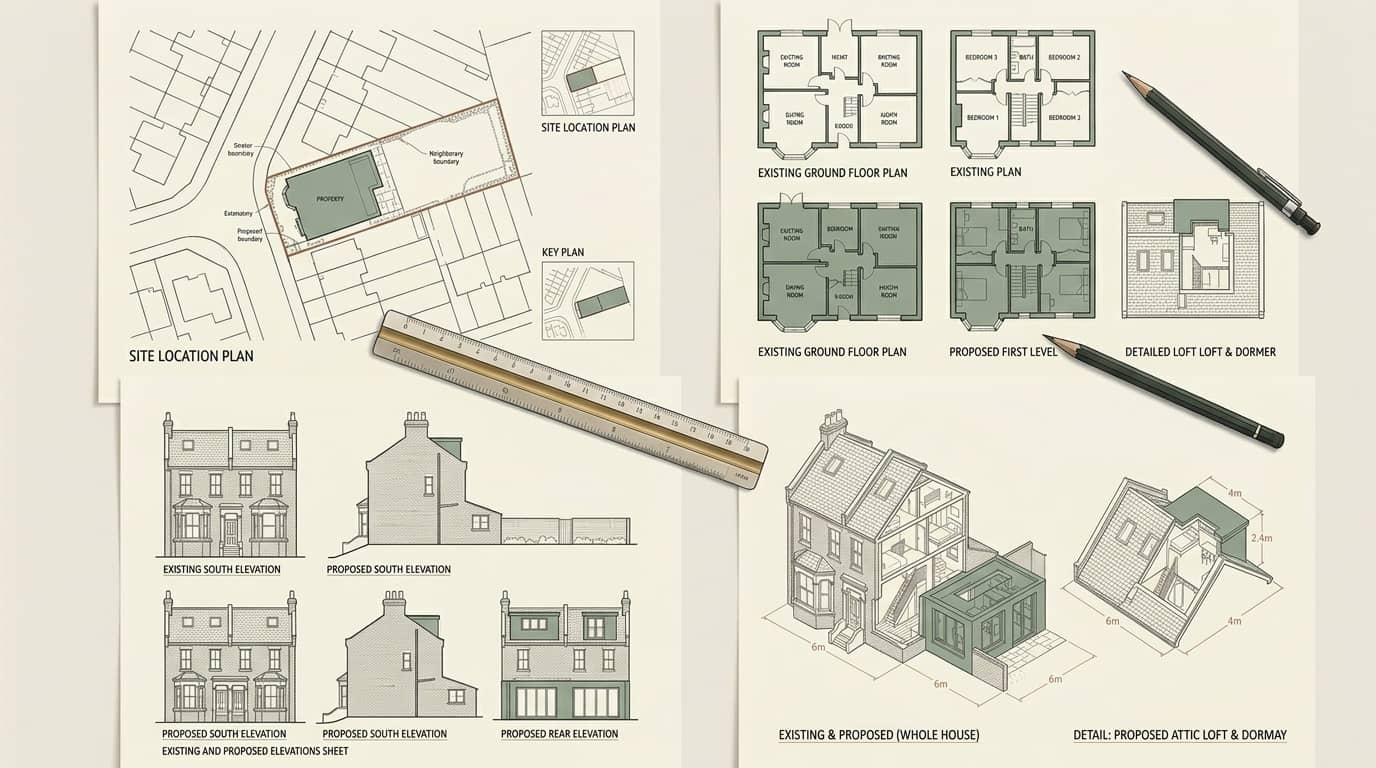
Survey drawing of listed building fabric in Sefton Park

When do you need listed building consent in Sefton Park?

Consent from Liverpool City Council is required for works affecting special interest. That commonly includes:

  • Removing, altering or forming internal walls, doorways or staircases
  • Replacing windows or doors, including like-for-like where detail changes
  • Re-roofing in a different material, or altering chimneys
  • Internal insulation, damp treatment or re-plastering in historic fabric
  • New services routed through historic fabric — heating, wiring, ventilation
  • Works to curtilage structures such as walls, outbuildings and railings
  • Demolition of any part of the building, however small
  • Signage, external lighting or satellite equipment fixed to the building

Sefton Park heritage decisions — live from council data

Below is Liverpool City Council's real decision record, drawn from official planning statistics and refreshed as new data lands. Liverpool grants the large majority of applications, but around Sefton Park the density of conservation areas and the registered-park setting are the constraints that most shape design. Listed applications are decided on the quality of the record and the justification, which is where most refusals actually originate.

Source: MHCLG planning application statistics (householder decisions, England, 1 April 2025 - 31 March 2026). Compare every borough on our London approval-rate league table.

92%householder applications approved in Liverpool
87%national average — Liverpool is 5 points above the national average

Ready for drawings your council will approve?

Tell us about your project and get a fixed, no-obligation quote back within one working day. If you don't need planning permission at all, we'll tell you that too — for free.

Get your free fixed quote

60 seconds now. A fixed, no-obligation quote back within one working day — and we'll tell you if you don't even need planning.

No obligation · No spam · Reply within 1 working day

What gets consented on listed buildings in Sefton Park

Across Sefton Park, Lark Lane and Princes Park, the schemes that get consent tend to be reversible, legible and honest: new work that reads as new rather than as imitation, services routed in existing chases rather than cut into original fabric, and interventions concentrated in later or lower-significance parts of the building. Rear additions in a contemporary idiom are often accepted where a pastiche extension is refused.

The setting of the Grade I registered Sefton Park landscape weighs on the scale and materials of any addition on adjoining plots. Where planning permission is needed as well — for an extension, say — the two applications run in parallel and are usually determined together. We prepare them as a single coordinated set so the heritage case and the planning case do not contradict each other, which is a surprisingly common reason for a refusal on an otherwise sound scheme.

Listed building consent drawing pack for a property in Sefton Park

Listed building work across Sefton Park

We prepare listed building consent packs across Sefton Park. A few of the areas where heritage work comes up most often:

Sefton Park

Listed building consent drawings for Sefton Park — large Victorian villas ringing the Grade I registered park under strict conservation control — surveyed as existing and drawn to the detail Liverpool City Council's conservation officer needs.

Lark Lane

Listed building consent drawings for Lark Lane — Victorian terraces behind the Lark Lane conservation area and its shopping street — surveyed as existing and drawn to the detail Liverpool City Council's conservation officer needs.

Princes Park

Listed building consent drawings for Princes Park — early-Victorian villas and terraces around the historic Paxton park — surveyed as existing and drawn to the detail Liverpool City Council's conservation officer needs.

Princes Road

Listed building consent drawings for Princes Road — grand boulevard frontages in the Princes Road / Toxteth avenues conservation area — surveyed as existing and drawn to the detail Liverpool City Council's conservation officer needs.

Sunnyside

Listed building consent drawings for Sunnyside — dense Victorian streets between the parks with heavy conversion pressure — surveyed as existing and drawn to the detail Liverpool City Council's conservation officer needs.

Windermere Terrace

Listed building consent drawings for Windermere Terrace — listed Italianate terrace overlooking Sefton Park — surveyed as existing and drawn to the detail Liverpool City Council's conservation officer needs.

Listed building consent or planning permission in Sefton Park?

They are separate consents with different tests, and many projects need both.

ConsentWhat it coversFeeConsequence of proceeding without it
Listed building consentWorks affecting special interest, internal and externalNoneCriminal offence under section 9 of the 1990 Act
Planning permissionDevelopment — extensions, outbuildings, use changesPayableEnforcement action; may become immune after 10 years
Conservation area consent contextDemolition and character in a designated areaVariesEnforcement; prosecution for unauthorised demolition
Building regulationsStructure, fire, insulation, ventilationPayableEnforcement notice; problems on sale

Sources: Planning (Listed Buildings and Conservation Areas) Act 1990, sections 7, 9 and 16(2); Town and Country Planning Act 1990.

Four steps to consent on a Sefton Park listed building

A process built around what a conservation officer actually assesses.

  1. 1

    Free initial check

    Send us the address and the listing entry. We confirm grade, what the listing covers, whether curtilage structures are caught, and how Liverpool City Council has treated comparable schemes.

  2. 2

    Measured record of the building

    We survey as existing in real detail — plans, elevations, sections and the features that carry the significance — because a proposal cannot be assessed against a record that does not exist.

  3. 3

    Proposal & heritage statement

    We draw the proposal in matching detail and write the heritage statement that identifies significance, impact and justification in the terms section 16(2) requires.

  4. 4

    Submission & follow-through

    We submit to Liverpool City Council, engage with the conservation officer, and revise the drawings free until the decision is issued.

Frequently asked questions

Do I need listed building consent for internal work in Sefton Park?

Frequently, yes. Listing covers the whole building, so removing a partition, altering a staircase, replacing joinery or re-plastering historic surfaces can all require consent from Liverpool City Council. There is no internal exemption and no size threshold. The safe route is to establish what is significant before work is designed, which is what the measured survey is for. This applies to your Sefton Park address specifically.

What happens if work is done without listed building consent in Sefton Park?

Carrying out unauthorised works to a listed building is a criminal offence under section 9 of the Planning (Listed Buildings and Conservation Areas) Act 1990, and it does not become lawful with the passage of time the way some planning breaches do. Liverpool City Council can require reinstatement. Where work has already happened, an application for retrospective consent is usually the right first step, and we can advise on it. This applies to your Sefton Park address specifically.

Is there a fee for listed building consent in Sefton Park?

No. Listed building consent applications carry no application fee, which sometimes leads owners to assume the process is lighter than a planning application. It is not — the evidence expected is greater, because the decision rests on the effect on special interest rather than on amenity, and an under-documented submission is the most common cause of delay. This applies to your Sefton Park address specifically. Liverpool City Council is the decision-maker.

Do I need planning permission as well as listed building consent in Sefton Park?

If the work is also development — an extension, an outbuilding, a change of use — then yes, and the two applications run in parallel to Liverpool City Council. Internal alterations usually need only listed building consent. Where both are required we prepare them as one coordinated set, because inconsistencies between the two submissions are a recurring reason for delay. This applies to your Sefton Park address specifically.

Can I replace the windows in a listed building in Sefton Park?

Sometimes, but rarely with modern units. Historic windows are often the single most significant surviving feature, and replacement is judged on the condition of the existing joinery and the accuracy of what replaces it — glazing bar profile, glass type, opening method and reveal depth all matter. Repair and secondary glazing are usually the route that gains consent, particularly inside designated areas such as Sefton Park and Princes Park. Liverpool City Council is the decision-maker.

How long does listed building consent take in Sefton Park?

The statutory target is eight weeks from validation for most applications, and thirteen for larger schemes. In practice the timetable is set by how complete the submission is: a conservation officer who has to ask what the existing fabric looks like will take longer than one who can see it. We submit a record that answers those questions upfront. This applies to your Sefton Park address specifically. Liverpool City Council is the decision-maker.

How much do listed building drawings in Sefton Park cost?

We quote each Sefton Park listed project individually, because the survey effort depends entirely on the building's complexity and how much of the fabric the work touches, and send a fixed, no-obligation quote within one working day. It covers survey, drawings and heritage statement, with free revisions until Liverpool City Council decides. Call 020 7864 7245 to start.

Planning approval report

Know your approval odds before you spend a penny on drawings

Answer five quick questions and get a free planning score for your exact address — instantly. Then, if you want the full picture, unlock the detailed analysis: your council's live approval rates, local precedents, constraints on your street and a step-by-step route to permission.

Listed building consent drawings across Liverpool

Same fixed quotes, same fast drawings — wherever your project is.

Other planning services in Sefton Park