MCIAT chartered drawings · Fixed fees across all 33 London boroughs
Services
Areas
Guides
ProcessOur promiseFAQ
Free approval reportGet my free quote020 7864 7245
Larger home extension prior approval in Vale of White Horse — a deep single-storey rear extension to a house
Vale of White Horse · Prior Approval & Neighbour Consultation

Larger home extension prior approval in Vale of White Horse

The fast route to a deep single-storey rear extension in Vale of White Horse — up to 6 metres on an attached house or 8 on a detached one — via Vale of White Horse District Council's prior approval scheme rather than a full planning application.

★★★★★ Rated 4.9/5 by London homeowners96% approval rate · 2,400+ drawings delivered
Share

Vale of White Horse householder planning by the numbers

Vale of White Horse District Council granted 96% of the householder planning decisions it made in its latest published year — 9 points above the 87% England-wide householder average. Vale of White Horse contains Abingdon - Albert Park Conservation Area, Appleton Conservation Area, Ardington and East Lockinge Conservation Area conservation areas (Abingdon - Albert Park Conservation Area designated 1975), so materials, fenestration and roof form are assessed against the appraisal, which is where a policy-literate drawing pack earns its keep. Its dominant Victorian (1837–1901) and postwar (1945–1970) housing stock sets the design brief on most streets.

Under Class B, a rear dormer stays permitted development up to 40m³ of added roof volume on a terrace or 50m³ on a semi-detached or detached house, while Class A allows a single-storey rear extension of 3m beyond the original rear wall on a terrace and 4m on a detached house before a full application is needed. In conservation areas such as Abingdon - Albert Park Conservation Area, Appleton Conservation Area and Ardington and East Lockinge Conservation Area those rights are removed, so we confirm your exact address before a line is drawn. A validated householder application in Vale of White Horse is determined against an 8-week statutory target.

Abingdon - Albert Park (conservation area designated in 1975), Appleton (conservation area designated in 1969), Ardington and East Lockinge (conservation area designated in 1970), Baulking (conservation area designated in 1971), Blewbury (conservation area designated in 1970), Buckland (conservation area designated in 1971), Charney Bassett (conservation area designated in 1978), Childrey (conservation area designated in 1970), Abingdon Fitzharris (ward of Vale of White Horse), Ridgeway (ward of Vale of White Horse), Stanford (ward of Vale of White Horse), Blewbury & Harwell (ward of Vale of White Horse), Drayton (ward of Vale of White Horse), Sutton Courtenay (ward of Vale of White Horse), Thames (ward of Vale of White Horse) and Faringdon (ward of Vale of White Horse) — these are the Vale of White Horse pockets our drawings cover most. Heritage designations here include Abingdon - Albert Park Conservation Area, Appleton Conservation Area, Ardington and East Lockinge Conservation Area, Baulking Conservation Area, Blewbury Conservation Area, Buckland Conservation Area, Charney Bassett Conservation Area and Childrey Conservation Area. Vale of White Horse District Council weighs each proposal against Vale of White Horse District Council's development plan and the design policies it applies to householder applications, where the 36,310 homes here are 11% pre-1900, 8% 1955-1964, 6% 1965-1972, which is what sets the realistic roof and rear-projection options. On roofs the borough is steeply pitched slate roofs, valley gutters and party parapets typical of pre-1900 building and shallow gabled roofs typical of that period's building, over Victorian and earlier houses (11% of 36,310 homes), late-1950s and early-1960s houses (8%) and late-1960s and early-1970s houses (6%).

What actually constrains a project in Vale of White Horse

Vale of White Horse's designated heritage is specific, and it is the first thing we check against your address: Abingdon - Albert Park (conservation area designated in 1975), Appleton (conservation area designated in 1969), Ardington and East Lockinge (conservation area designated in 1970), Baulking (conservation area designated in 1971), Blewbury (conservation area designated in 1970), Buckland (conservation area designated in 1971), Charney Bassett (conservation area designated in 1978) and Childrey (conservation area designated in 1970). Inside those boundaries permitted development is curtailed and Vale of White Horse District Council assesses materials, window detail and roof form against the area's own appraisal, so a scheme that would be waved through two streets away can need a full application here.

Beyond the designated areas, Vale of White Horse takes in Abingdon Fitzharris, Ridgeway, Stanford, Blewbury & Harwell, Drayton, Sutton Courtenay, Thames and Faringdon. No Article 4 direction is recorded for Vale of White Horse District Council, but the district's 8 conservation areas still limit permitted development on those streets.

On stock, Vale of White Horse is Victorian and earlier houses (11% of 36,310 homes), late-1950s and early-1960s houses (8%) and late-1960s and early-1970s houses (6%) — which is why steeply pitched slate roofs, valley gutters and party parapets typical of pre-1900 building and shallow gabled roofs typical of that period's building govern what a loft or rear projection can realistically be. Vale of White Horse District Council decided 563 householder applications in the latest published year and granted 96%, with 57% issued inside the eight-week target. Those are the numbers our drawings are prepared against.

The full build-period split for Vale of White Horse runs pre-1900 3% (190 homes), 1900-1918 0% (30 homes), 1919-1929 0% (10 homes), 1930-1939 6% (350 homes), 1945-1954 3% (170 homes), 1955-1964 30% (1,850 homes), 1965-1972 33% (1,990 homes), 1973-1982 4% (260 homes), 1983-1992 5% (310 homes), 1993-1999 4% (220 homes) and 2000-2008 3% (170 homes). That distribution is why pre-1900 detailing dominates the drawings here, and it is measured from council-tax records rather than assumed from the street name.

Vale of White Horse District Council also decides for Abingdon Fitzharris, Ridgeway, Stanford, Blewbury & Harwell, Drayton, Sutton Courtenay, Thames and Faringdon, so a decision in Vale of White Horse sits inside a wider pattern of decisions we track across the same authority — useful when an officer cites a precedent from the next area over.
Vale of White Horse in numbers — housing stock and planning decisions

Published figures for Vale of White Horse and Vale of White Horse District Council. These are the numbers that decide what is realistic on your street, so we work from them rather than from national averages.

MeasureVale of White Horse
Dwellings recorded36,310
Built pre-1900190 (3%)
Built 1900-191830 (0%)
Built 1919-192910 (0%)
Built 1930-1939350 (6%)
Built 1945-1954170 (3%)
Built 1955-19641,850 (30%)
Built 1965-19721,990 (33%)
Built 1973-1982260 (4%)
Built 1983-1992310 (5%)
Built 1993-1999220 (4%)
Built 2000-2008170 (3%)
Built before 191914%
Built 1919–19398%
Built 1945–200848%
Conservation areas in Vale of White Horse8 (Abingdon - Albert Park Conservation Area, Appleton Conservation Area…)
Conservation areas district-wide55
Article 4 directions recorded0
Householder applications decided563
Householder applications granted96%
Decided within 8 weeks57%

Dwelling stock from VOA council-tax data at 31 March 2025; conservation-area and Article 4 counts from planning.data.gov.uk (MHCLG); decision figures are Vale of White Horse District Council's own, from MHCLG live table PS2 for the year to 31 March 2026.

How the prior approval route works in Vale of White Horse

The ordinary Class A limits stop a single-storey rear extension at 3 metres on an attached house and 4 on a detached one. The larger home extension scheme doubles both, on condition that the council is told first. That notification is not an application for permission — the council cannot refuse on design, materials or policy grounds. It can only consider the effect on the amenity of adjoining premises, and only if a neighbour actually objects during the 21-day consultation.

The other conditions still apply and are strict: single storey only, no higher than 4 metres, eaves no higher than the existing eaves, and no more than half the land around the original house covered. It is not available on designated land, so a house in a conservation area such as Abingdon - Albert Park Conservation Area and Appleton Conservation Area cannot use it at all. Materials must be similar to the existing house, and the extension must not include a veranda, balcony or raised platform.

Vale of White Horse is largely Victorian and earlier houses (11% of 36,310 homes), late-1950s and early-1960s houses (8%) and late-1960s and early-1970s houses (6%). Vale of White Horse contains Abingdon - Albert Park Conservation Area, Appleton Conservation Area, Ardington and East Lockinge Conservation Area conservation areas (Abingdon - Albert Park Conservation Area designated 1975), so materials, fenestration and roof form are assessed against the appraisal, which matters here because an objecting neighbour puts amenity squarely in front of a case officer. No Article 4 direction is recorded for Vale of White Horse District Council, but the district's 8 conservation areas still limit permitted development on those streets.

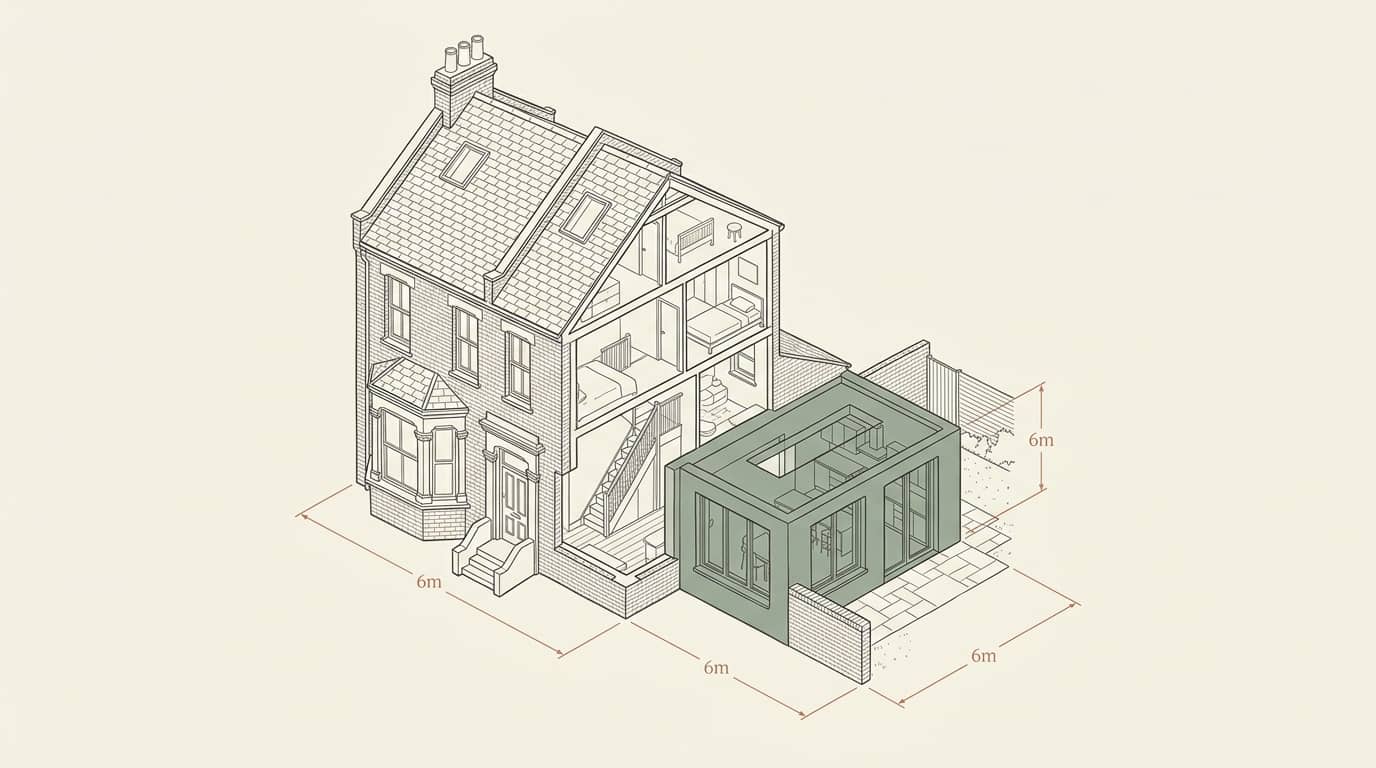
Isometric drawing of a deep rear extension in Vale of White Horse

Does your Vale of White Horse extension qualify for prior approval?

The scheme is available where all of these hold. Fail any one and it is a full application to Vale of White Horse District Council instead:

  • The extension is single storey and rear-facing
  • It projects no more than 6 metres on a terraced or semi-detached house, or 8 metres on a detached house
  • It is no more than 4 metres high, with eaves no higher than the existing eaves
  • The property is a house, not a flat or maisonette
  • The property is not on designated land — the scheme is unavailable in conservation areas such as Abingdon - Albert Park Conservation Area and Appleton Conservation Area
  • No more than half the land around the original house is covered by buildings
  • The materials are similar in appearance to the existing house
  • You notify the council BEFORE building — retrospective use of the scheme is not possible

Vale of White Horse householder decisions — live from council data

Below is Vale of White Horse District Council's real householder decision record, drawn from official planning statistics and refreshed as new data lands. Vale of White Horse District Council granted 96% of 563 householder decisions in the year to 31 March 2026, 57% of them inside eight weeks. Prior approval turns on neighbour amenity alone, so the drawings that matter are the ones showing the relationship to the boundary.

Source: MHCLG planning application statistics (householder decisions, England, 1 April 2025 - 31 March 2026). Compare every borough on our London approval-rate league table.

96%householder applications approved in Vale of White Horse
87%national average — Vale of White Horse is 9 points above the national average

Ready for drawings your council will approve?

Tell us about your project and get a fixed, no-obligation quote back within one working day. If you don't need planning permission at all, we'll tell you that too — for free.

Get your free fixed quote

60 seconds now. A fixed, no-obligation quote back within one working day — and we'll tell you if you don't even need planning.

No obligation · No spam · Reply within 1 working day

What gets through prior approval in Vale of White Horse

Across Abingdon - Albert Park, Appleton and Ardington and East Lockinge, the notifications that clear without objection are the ones that treat the neighbour as the audience. We show the extension in section against the boundary, demonstrate the 45-degree daylight relationship to the nearest habitable window, and where the plot is tight we taper the depth away from the boundary rather than running the full 6 metres to the fence.

The 36,310 homes here are 11% pre-1900, 8% 1955-1964, 6% 1965-1972, which is what sets the realistic roof and rear-projection options. Where an objection does arrive, the council's assessment is narrow: loss of light, outlook and overbearing effect on the adjoining property, nothing else. A pack that has already answered those three points on the drawings usually survives an objection, whereas one that leaves them to the officer's imagination usually does not.

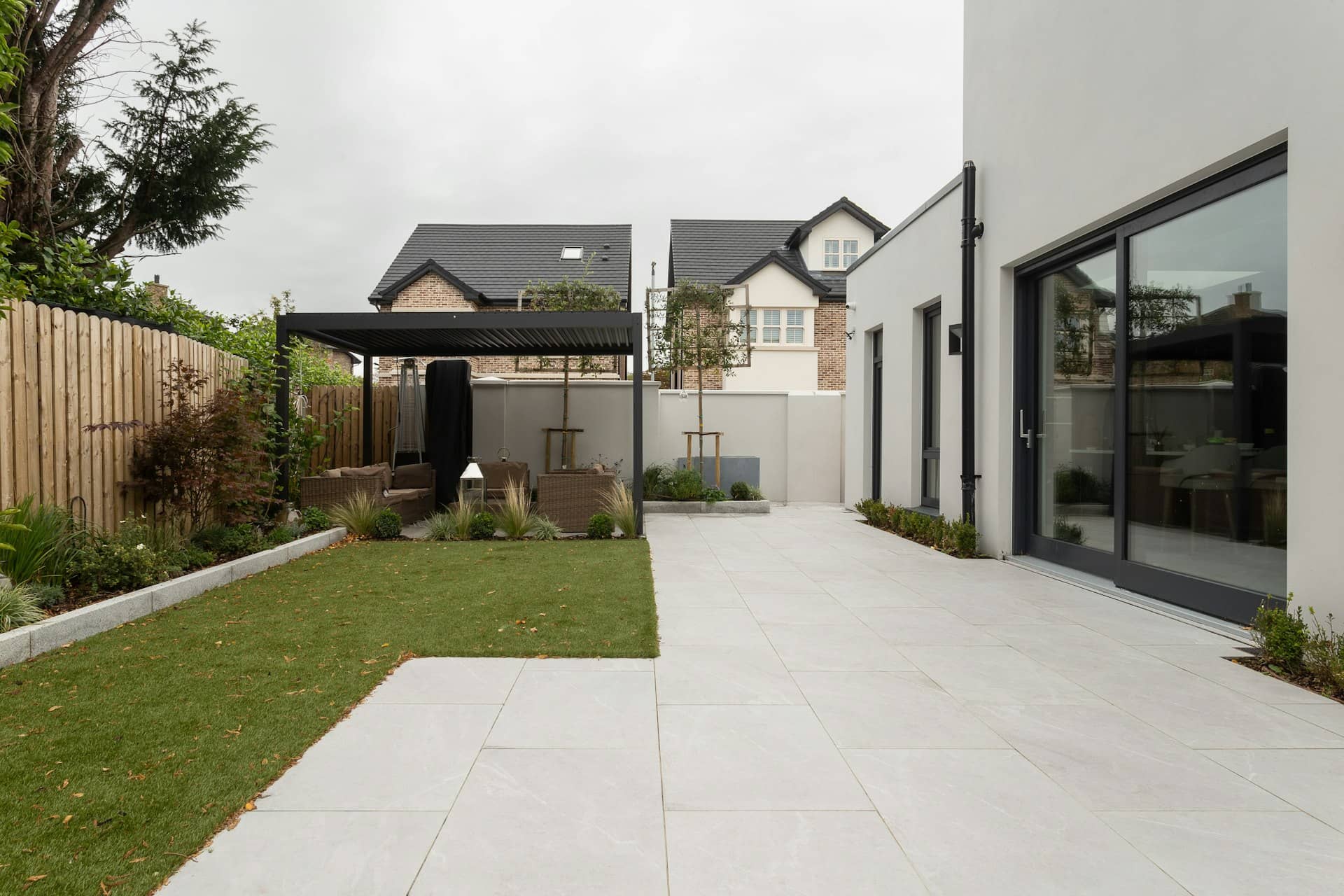
Deep single-storey rear extension to a house in Vale of White Horse

Larger home extensions across Vale of White Horse

We prepare prior-approval notifications across Vale of White Horse. A few of the areas where deep rear extensions come up most often:

Abingdon - Albert Park

Prior approval drawings for Abingdon - Albert Park — conservation area designated in 1975 — dimensioned to the 6m and 8m limits and prepared for Vale of White Horse District Council's neighbour consultation.

Appleton

Prior approval drawings for Appleton — conservation area designated in 1969 — dimensioned to the 6m and 8m limits and prepared for Vale of White Horse District Council's neighbour consultation.

Ardington and East Lockinge

Prior approval drawings for Ardington and East Lockinge — conservation area designated in 1970 — dimensioned to the 6m and 8m limits and prepared for Vale of White Horse District Council's neighbour consultation.

Baulking

Prior approval drawings for Baulking — conservation area designated in 1971 — dimensioned to the 6m and 8m limits and prepared for Vale of White Horse District Council's neighbour consultation.

Blewbury

Prior approval drawings for Blewbury — conservation area designated in 1970 — dimensioned to the 6m and 8m limits and prepared for Vale of White Horse District Council's neighbour consultation.

Buckland

Prior approval drawings for Buckland — conservation area designated in 1971 — dimensioned to the 6m and 8m limits and prepared for Vale of White Horse District Council's neighbour consultation.

Prior approval or full application in Vale of White Horse?

Same extension, two routes, very different tests.

RouteDepth allowedWhat the council may considerTimescale
Ordinary Class A permitted development3m attached / 4m detachedNothing — no application neededImmediate
Larger home extension prior approval6m attached / 8m detachedAmenity of adjoining premises, only if a neighbour objects21-day consultation, 42-day determination
Full householder applicationNo fixed limitDesign, materials, policy, amenity, everything8-week target
Any of these on designated land3m / 4m onlyPrior approval scheme unavailableFull application beyond the limits

Limits and procedure from the GPDO 2015, Schedule 2, Part 1, Class A and paragraph A.4, made permanent by amendment in 2019.

Four steps to prior approval in Vale of White Horse

A process built around the 21-day consultation, which is where these schemes are won or lost.

  1. 1

    Free eligibility check

    Send us your Vale of White Horse postcode and house type. We confirm whether the property is on designated land, whether the scheme is available, and what depth you can realistically take.

  2. 2

    Measured survey

    We measure the original rear wall, eaves height, boundary distances and the neighbouring windows that the amenity assessment will turn on.

  3. 3

    Notification pack

    We draw the extension to the 6m or 8m limit with the boundary relationship shown in section, and prepare the written description and adjoining-owner details Vale of White Horse District Council needs to start the consultation.

  4. 4

    Consultation & follow-through

    We submit, track the 21-day consultation and the 42-day determination, respond to any objection on amenity grounds, and revise free until the decision.

Frequently asked questions

How deep can a rear extension be in Vale of White Horse without planning permission?

Three metres on a terraced or semi-detached house and four on a detached one under ordinary permitted development. Under the larger home extension prior approval scheme those double to six and eight metres, provided you notify Vale of White Horse District Council before starting and the conditions on height, materials and land coverage are met. The scheme is not available on designated land.

What is prior approval for a larger home extension in Vale of White Horse?

It is a notification, not an application for permission. You tell Vale of White Horse District Council what you intend to build, it writes to the adjoining owners, and they have 21 days to object. If nobody objects, you may build. If someone does, the council assesses the effect on the amenity of adjoining premises and must decide within 42 days. Design and policy are not in scope.

What happens if my neighbour objects in Vale of White Horse?

The council then considers the impact on the amenity of the adjoining property — loss of light, loss of outlook, and overbearing effect — and nothing else. It cannot refuse because it dislikes the design or the materials. We prepare the drawings so those three questions are already answered in section and on the site plan, which is what usually carries an objected scheme through. This applies to your Vale of White Horse address specifically. Vale of White Horse District Council is the decision-maker.

Can I use prior approval in a Vale of White Horse conservation area?

No. The larger home extension scheme is unavailable on designated land, which includes conservation areas such as Abingdon - Albert Park Conservation Area and Appleton Conservation Area, national landscapes, national parks and world heritage sites. On those properties the ordinary 3-metre and 4-metre limits apply, and anything deeper needs a full householder application to Vale of White Horse District Council.

How long does prior approval take in Vale of White Horse?

Twenty-one days for the neighbour consultation, and a maximum of 42 days from a valid submission for the council to determine it. If the council does not respond within 42 days you may proceed as notified. That deadline is the scheme's real advantage over a full application, and it is why validation completeness matters so much. This applies to your Vale of White Horse address specifically. Vale of White Horse District Council is the decision-maker.

Do I still need building regulations approval in Vale of White Horse?

Yes — always. Prior approval deals only with the planning position. A 6-metre rear extension still needs building control approval for foundations, structure, drainage, thermal performance and fire safety, and the beam over the opening into the existing house needs designing and calculating. We prepare both sets so the notified scheme is the buildable one. This applies to your Vale of White Horse address specifically. Vale of White Horse District Council is the decision-maker.

How much do prior approval drawings in Vale of White Horse cost?

We quote each Vale of White Horse scheme individually, because plot shape and the boundary relationship drive the work, and send a fixed, no-obligation quote within one working day. It covers the notification pack and free revisions until Vale of White Horse District Council determines it. Call 020 7864 7245 to start.

Planning approval report

Know your approval odds before you spend a penny on drawings

Answer five quick questions and get a free planning score for your exact address — instantly. Then, if you want the full picture, unlock the detailed analysis: your council's live approval rates, local precedents, constraints on your street and a step-by-step route to permission.

Larger home extension prior approval across Vale of White Horse

Same fixed quotes, same fast drawings — wherever your project is.

Other planning services in Vale of White Horse