MCIAT chartered drawings · Fixed fees across all 33 London boroughs
Services
Areas
Guides
ProcessOur promiseFAQ
Free approval reportGet my free quote020 7864 7245
Dormer loft conversion plans in Exe Valley — a full-height attic bedroom under a rear box dormer
Exe Valley · Dormer Loft Conversion Drawings & Planning

Dormer loft conversion plans in Exe Valley

Rear dormer drawings for Exe Valley roofs — the box across the back slope that turns a low attic into a full-height room, drawn to East Devon District Council's guidance and the volume limits, delivered in days and revised free until your decision, with a free approval-odds check first.

★★★★★ Rated 4.9/5 by London homeowners96% approval rate · 2,400+ drawings delivered
Share

What the data says about planning in Exe Valley

East Devon District Council granted 94% of the householder planning decisions it made in its latest published year — 7 points above the 87% England-wide householder average. Exe Valley contains the Brampford Speke conservation area (Brampford Speke designated 1976), so materials, fenestration and roof form are assessed against the appraisal, which is where a policy-literate drawing pack earns its keep. Its dominant Victorian (1837–1901) and postwar (1945–1970) housing stock sets the design brief on most streets.

Class A and Class B set the thresholds — a rear dormer to 40m³ on a terrace or 50m³ on a semi or detached, and a single-storey rear extension to 3m on a terrace or 4m on a detached house — beyond which East Devon District Council needs a full application. In conservation areas such as Brampford Speke those rights are removed, so we confirm your exact address before a line is drawn. A validated householder application in Exe Valley is determined against an 8-week statutory target.

Brampford Speke (conservation area designated in 1976), Nether Exe (civil parish within Exe Valley), Poltimore (civil parish within Exe Valley), Rewe (civil parish within Exe Valley), Stoke Canon (civil parish within Exe Valley), Upton Pyne (civil parish within Exe Valley) and Brampford Speke (civil parish within Exe Valley) — these are the Exe Valley pockets our drawings cover most. Heritage designations here include Brampford Speke. East Devon District Council weighs each proposal against East Devon District Council's development plan and the design policies it applies to householder applications, where the 980 homes here are 33% pre-1900, 20% 1965-1972, 7% 1955-1964, which is what sets the realistic roof and rear-projection options. On roofs the borough is steeply pitched slate roofs, valley gutters and party parapets typical of pre-1900 building and shallow-pitched roofs and integral garages typical of that period's building, over Victorian and earlier houses (33% of 980 homes), late-1960s and early-1970s houses (20%) and late-1950s and early-1960s houses (7%).

Designations, stock and decisions in Exe Valley

Heritage designation is the single biggest variable in Exe Valley, and it is address-specific: Brampford Speke (conservation area designated in 1976). Inside those boundaries permitted development is curtailed and East Devon District Council assesses materials, window detail and roof form against the area's own appraisal, so a scheme that would be waved through two streets away can need a full application here.

Beyond the designated areas, Exe Valley takes in Nether Exe, Poltimore, Rewe, Stoke Canon, Upton Pyne and Brampford Speke. No Article 4 direction is recorded for East Devon District Council, but Exe Valley's 1 conservation area still limit permitted development on those streets.

On stock, Exe Valley is Victorian and earlier houses (33% of 980 homes), late-1960s and early-1970s houses (20%) and late-1950s and early-1960s houses (7%) — which is why steeply pitched slate roofs, valley gutters and party parapets typical of pre-1900 building and shallow-pitched roofs and integral garages typical of that period's building govern what a loft or rear projection can realistically be. East Devon District Council decided 587 householder applications in the latest published year and granted 94%, with 72% issued inside the eight-week target. We work from the council's own published record.

The full build-period split for Exe Valley runs pre-1900 33% (320 homes), 1900-1918 2% (20 homes), 1919-1929 1% (10 homes), 1930-1939 5% (50 homes), 1945-1954 5% (50 homes), 1955-1964 7% (70 homes), 1965-1972 20% (200 homes), 1973-1982 6% (60 homes), 1983-1992 7% (70 homes), 1993-1999 4% (40 homes) and 2000-2008 5% (50 homes). That distribution is why pre-1900 detailing dominates the drawings here, and it is measured from council-tax records rather than assumed from the street name.

East Devon District Council also decides for Axminster, Beer & Branscombe, Broadclyst, Budleigh & Raleigh, Clyst Valley, Coly Valley, Dunkeswell & Otterhead and Feniton, so a decision in Exe Valley sits inside a wider pattern of decisions we track across the same authority — useful when an officer cites a precedent from the next area over.
The published numbers behind a Exe Valley application

Published figures for Exe Valley and East Devon District Council. These are the numbers that decide what is realistic on your street, so we work from them rather than from national averages.

MeasureExe Valley
Dwellings recorded980
Built pre-1900320 (33%)
Built 1900-191820 (2%)
Built 1919-192910 (1%)
Built 1930-193950 (5%)
Built 1945-195450 (5%)
Built 1955-196470 (7%)
Built 1965-1972200 (20%)
Built 1973-198260 (6%)
Built 1983-199270 (7%)
Built 1993-199940 (4%)
Built 2000-200850 (5%)
Built before 191935%
Built 1919–19396%
Built 1945–200855%
Conservation areas in Exe Valley1 (Brampford Speke)
Conservation areas district-wide32
Article 4 directions recorded0
Householder applications decided587
Householder applications granted94%
Decided within 8 weeks72%

Dwelling stock from VOA council-tax data at 31 March 2025; conservation-area and Article 4 counts from planning.data.gov.uk (MHCLG); decision figures are East Devon District Council's own, from MHCLG live table PS2 for the year to 31 March 2026.

The rear dormer, drawn for Exe Valley roofs

The box dormer is the workhorse loft, and most of Exe Valley is built for it — the borough runs to Victorian and earlier houses (33% of 980 homes), late-1960s and early-1970s houses (20%) and late-1950s and early-1960s houses (7%) under steeply pitched slate roofs, valley gutters and party parapets typical of pre-1900 building and shallow-pitched roofs and integral garages typical of that period's building, and a flat-roofed box across the rear slope is the cheapest cubic metre of full-height space those roofs give up. East Devon District Council tests the dormer against East Devon District Council's development plan and the design policies it applies to householder applications, and because permitted development turns on a number, the volume you propose against the volume you have left is the first thing an officer or a certificate checks.

That is why the arithmetic goes on the drawings. We calculate the box against the 40- or 50-cubic-metre allowance, count any earlier roof enlargement into the total, hold the flat roof below the ridge and set the face back off the eaves so the dormer reads as subordinate. Exe Valley contains the Brampford Speke conservation area (Brampford Speke designated 1976), so materials, fenestration and roof form are assessed against the appraisal, so the cheeks, the window line and the material are drawn to answer it rather than invite a query.

Where Exe Valley's streets are protected — Brampford Speke among them — the Class B dormer right is switched off and even a modest rear box needs consent. No Article 4 direction is recorded for East Devon District Council, but Exe Valley's 1 conservation area still limit permitted development on those streets. We confirm the designation before the box is sized.

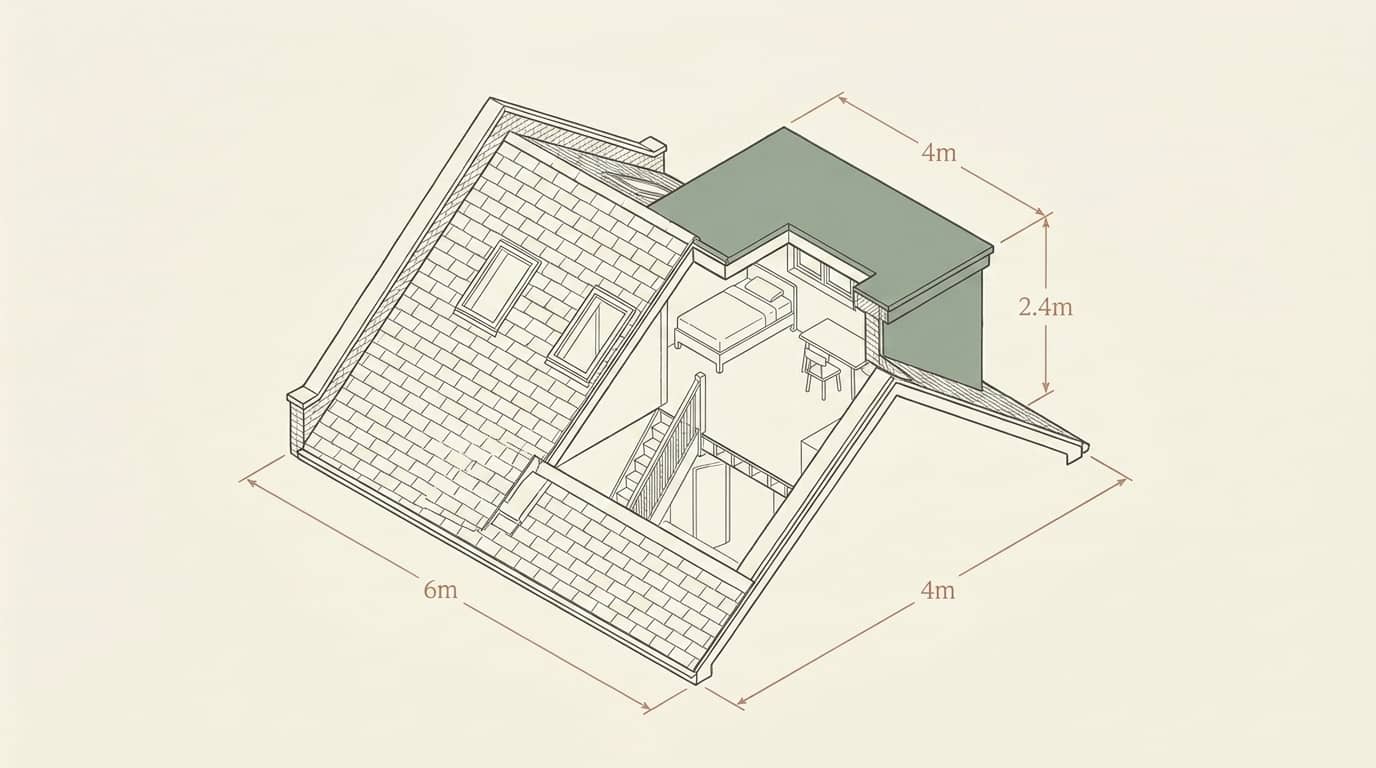
Isometric rear box dormer drawing for a Exe Valley house

Does a dormer need planning permission in Exe Valley?

Many rear dormers in Exe Valley are permitted development, but the volume and position decide it. You will normally need a full application to East Devon District Council if any of these apply:

  • The box would take the roof over 40 cubic metres on a terrace, or 50 on a semi-detached or detached house — including any earlier loft enlargement
  • The dormer faces the highway or would be built on the front roof slope
  • The dormer rises above the existing ridge, or sits on or forward of the original eaves rather than set back
  • The house is in a conservation area such as Brampford Speke, where Class B dormer rights are removed

Exe Valley dormer approval rates — live from council data

Below is East Devon District Council's real householder decision record, drawn from official planning statistics and refreshed as new data lands. East Devon District Council granted 94% of its householder applications in the year to 31 March 2026, and Brampford Speke shapes what is approved here. A dormer is decided on volume and set-back, so a pack that shows the calculation and the eaves detail is cleared faster and refused less often than a DIY submission.

Source: MHCLG planning application statistics (householder decisions, England, 1 April 2025 - 31 March 2026). Compare every borough on our London approval-rate league table.

94%householder applications approved in East Devon
87%national average — East Devon is 7 points above the national average

Ready for drawings your council will approve?

Tell us about your project and get a fixed, no-obligation quote back within one working day. If you don't need planning permission at all, we'll tell you that too — for free.

Get your free fixed quote

60 seconds now. A fixed, no-obligation quote back within one working day — and we'll tell you if you don't even need planning.

No obligation · No spam · Reply within 1 working day

What dormers get approved in Exe Valley

Across Brampford Speke, Nether Exe and Poltimore, the dormer that goes through is the subordinate rear box: flat roof kept low, cheeks clad to recede, side windows obscure-glazed against overlooking, and the whole thing set back so the original eaves line still reads from the garden. On steeply pitched slate roofs, valley gutters and party parapets typical of pre-1900 building, this returns a full-height double and en-suite from what was standing-room-only, usually inside the permitted-development volume.

The 980 homes here are 33% pre-1900, 20% 1965-1972, 7% 1955-1964, which is what sets the realistic roof and rear-projection options. We keep the box off the ridge, match the cheek material to the roof, and where the volume is already spent — or the street is designated — draw the dormer as a householder application composed to East Devon District Council's roof-alteration guidance rather than push a certificate that would be refused.

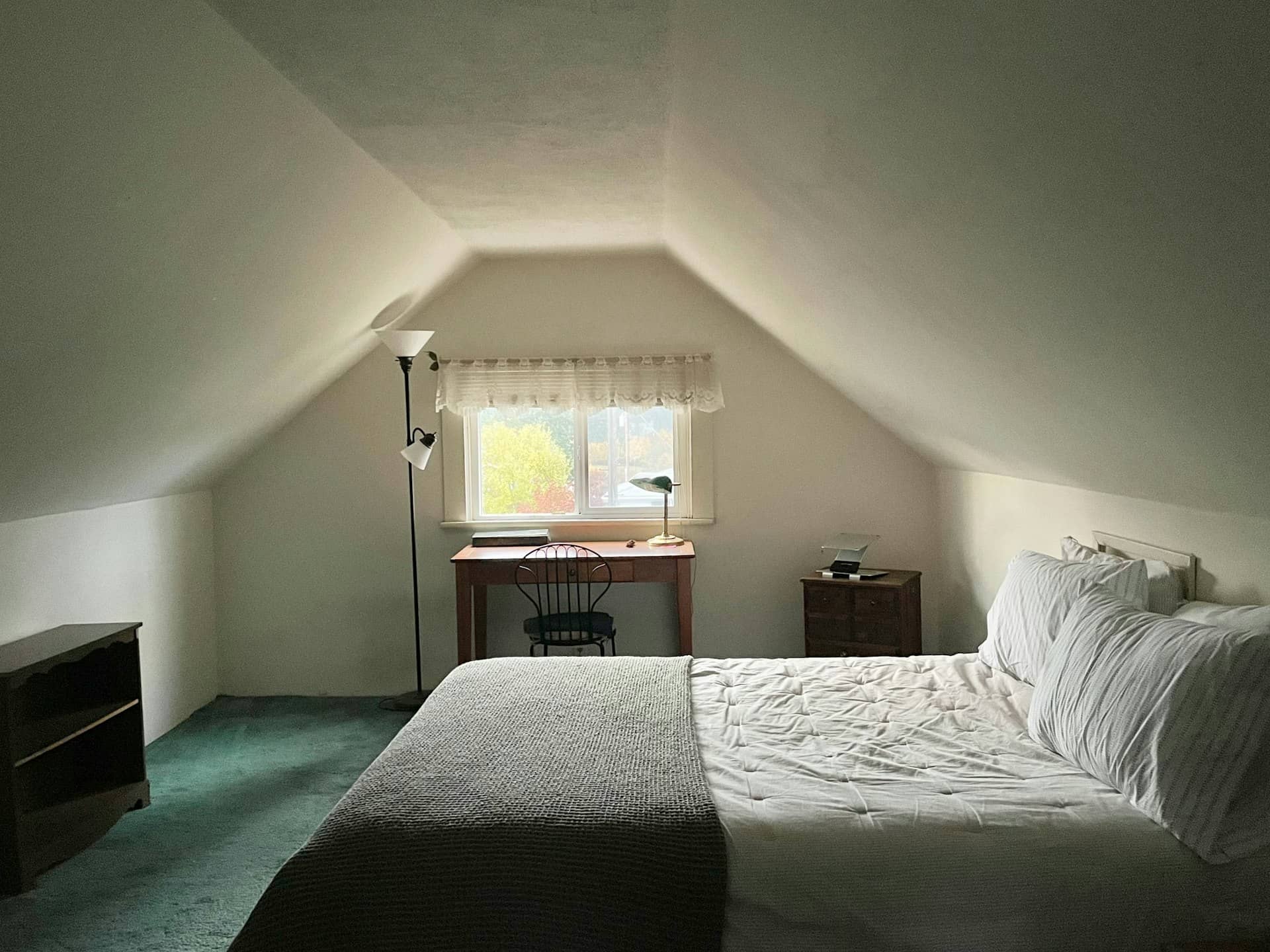
Rear dormer bedroom built to approved drawings in Exe Valley

Dormer loft conversions across Exe Valley

We draw rear dormers on the terraced and semi-detached streets across the borough. A few of the neighbourhoods where Exe Valley dormers come up most often:

Brampford Speke

Dormer loft drawings for Brampford Speke's conservation area designated in 1976 — volume-checked, set-back-detailed and drawn to East Devon District Council's guidance.

Nether Exe

Dormer loft drawings for Nether Exe's civil parish within Exe Valley — volume-checked, set-back-detailed and drawn to East Devon District Council's guidance.

Poltimore

Dormer loft drawings for Poltimore's civil parish within Exe Valley — volume-checked, set-back-detailed and drawn to East Devon District Council's guidance.

Rewe

Dormer loft drawings for Rewe's civil parish within Exe Valley — volume-checked, set-back-detailed and drawn to East Devon District Council's guidance.

Stoke Canon

Dormer loft drawings for Stoke Canon's civil parish within Exe Valley — volume-checked, set-back-detailed and drawn to East Devon District Council's guidance.

Upton Pyne

Dormer loft drawings for Upton Pyne's civil parish within Exe Valley — volume-checked, set-back-detailed and drawn to East Devon District Council's guidance.

Is your Exe Valley dormer permitted development or a full application?

Whether a dormer in Exe Valley needs permission comes down to where it sits and how big the box is. This is how the cases compare.

Dormer typePermitted development?What it gainsWhat East Devon District Council checks
Rear box, within volumeUsually yesFull-height room across the backVolume total, 20cm eaves set-back
Rear box, over volume limitNo — full applicationA larger roomHow far over the allowance, bulk
Front or side dormerNo — full applicationLight to the front roomsVisibility from the street, character
Dormer in a conservation areaNo — full applicationSame space, extra scrutinyRoof form and street appearance

In conservation areas such as Brampford Speke, Class B dormer rights are removed and every dormer needs a full application.

Four steps to an approved Exe Valley dormer

A fixed process built around how East Devon District Council validates and decides dormer applications — most drawings are submission-ready within seven days of survey.

  1. 1

    Free approval check

    Send us your Exe Valley postcode and roof type. We confirm your conservation and Article 4 status, work out how much permitted-development volume you have left, and score your odds against live East Devon District Council decisions.

  2. 2

    Measured survey

    We measure ridge and eaves heights, roof pitch and the existing loft floor — the numbers the volume calculation, the set-back and the head heights depend on.

  3. 3

    Dormer design & drawings

    Chartered designers develop the box to your brief, drawn inside the Class B volume limits or, where those are exhausted or removed, to East Devon District Council's roof-alteration guidance.

  4. 4

    Submission & follow-through

    We submit the certificate or application, manage validation and case-officer queries, and revise the drawings free until East Devon District Council issues its decision.

Frequently asked questions

Does a dormer need planning permission in Exe Valley?

Often not. A rear box dormer within 40 cubic metres on a terrace, or 50 on a semi or detached house, set back at least 20 centimetres from the eaves and kept below the ridge, is usually permitted development. In Exe Valley you will need a full application to East Devon District Council for a front or side dormer, a box that exceeds the volume, and any dormer in a conservation area such as Brampford Speke, where those rights are removed.

How big can a dormer be in Exe Valley without planning permission?

The permitted-development limit is a volume, not a footprint: 40 cubic metres of added roof space on a terraced house and 50 on a semi-detached or detached one, and any earlier loft enlargement counts against that total. In Exe Valley the box must also sit below the ridge and back from the eaves. We measure your roof and calculate the exact volume you have left before drawing. East Devon District Council is the decision-maker.

Can I put a dormer on the front of my Exe Valley house?

Not under permitted development. A dormer on the front roof slope, or one facing a highway, always needs a full application to East Devon District Council, because it changes how the house reads from the street. Rear box dormers are far more likely to be approved — or to be permitted development outright — which is why almost every Exe Valley dormer we draw sits on the back slope.

Do I need a party wall agreement for a dormer in Exe Valley?

Often, on a terrace or semi. If the dormer or the loft steelwork meets the party wall with your neighbour, the Party Wall etc. Act applies and notice must be served before work starts — separately from East Devon District Council's planning decision. We flag the party-wall junction on the drawings so a surveyor can be appointed early and the build is not held up. This applies to your Exe Valley address specifically.

Do I need a lawful development certificate for a dormer in Exe Valley?

If your dormer is permitted development, a lawful development certificate from East Devon District Council is council-stamped proof of it — worth holding, because a buyer's solicitor will ask for it when you sell. We prepare and submit the certificate with the same measured drawing pack that shows the box within its volume allowance. This applies to your Exe Valley address specifically.

How much do dormer loft conversion plans in Exe Valley cost?

We price each Exe Valley dormer individually, because the roof pitch and the volume left vary house to house, and send a fixed, no-obligation quote within one working day. It covers the full drawing pack with free revisions until East Devon District Council approves, and we confirm at the outset whether your box is permitted development or needs an application. Call 020 7864 7245 to start.

Planning approval report

Know your approval odds before you spend a penny on drawings

Answer five quick questions and get a free planning score for your exact address — instantly. Then, if you want the full picture, unlock the detailed analysis: your council's live approval rates, local precedents, constraints on your street and a step-by-step route to permission.

Dormer loft conversion plans across East Devon

Same fixed quotes, same fast drawings — wherever your project is.

Other planning services in Exe Valley